Shipping Guides
Advantages of Removable Gooseneck (RGN) Trailers
Heavy equipment hauling can be cumbersome and difficult. For those of you who have shipped large equipment in the past, you know how technical the process can be. That is why the removable gooseneck (RGN) trailer was created. With an RGN you can hold heavy equipment lower to the ground and avoid issues with height permits and constraints.
What is a removable gooseneck trailer?
An RGN is a trailer with a front gooseneck that detaches from the main deck. The front of the deck can then be lowered to the ground so suitable equipment can load from the front.
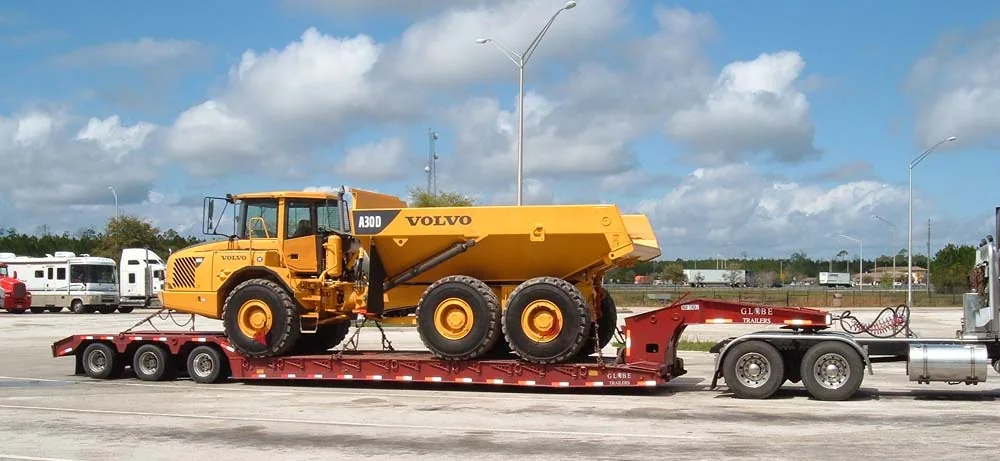
Heavy-haul RGNs commonly have a low main deck between raised front and rear sections. That lower area is called the well. It lets you carry tall machinery closer to the road than a conventional flatbed would.
The advantage is the combination: a low platform for transportation and front access for loading. If your machine needs both, an RGN is worth considering. Moto’s specialized freight page covers arranging open-deck and machinery transportation.
How the low deck helps with tall equipment
The height that matters is the machine sitting on the trailer, not the machine standing on the ground. A taller deck adds to the overall loaded height. A lower deck gives you more room for the equipment itself.
That can make an RGN useful for excavators, tractors and other machinery that sits too high on a standard flatbed. It does not automatically make the loaded combination suitable for every route.
The well also has a usable length and width. The machine must fit in that space with its weight supported appropriately. Attachments, tracks, wheels and anything projecting beyond the machine’s body all need to be accounted for.
Send dimensions in the condition the equipment will actually travel. If a boom can be lowered or an attachment removed, explain that and provide the resulting dimensions. A model name alone does not show the carrier what is attached to your machine.
How the removable neck makes loading easier
Once the trailer is positioned and the gooseneck detached, the front of the deck can be lowered for loading. Suitable wheeled or tracked machinery can be driven onto it rather than lifted onto a full-height platform.
After loading, the gooseneck is reconnected and the machine is secured for transportation. Reconnecting the trailer and securing the cargo are separate tasks; the gooseneck connection does not secure the machine.
Front loading can remove the need to lift a running machine with a crane, but it still takes planning. The equipment must be able to approach the deck, clear the transition and reach its travel position.
If the machine does not run, say so before booking. Explain whether it rolls, steers and brakes, and whether assistance is available. A non-running machine may need winching or lifting arrangements that must be confirmed with the carrier.
The loading site matters too. There needs to be suitable ground and enough room to position the truck, detach the neck and load. Confirm the same arrangements at delivery. Getting it aboard is only half the job.
What can you haul on an RGN trailer?
It is hard to beat a removable gooseneck trailer for hauling cargo. These trailers have a long hitch that extends up to the top of the vehicle's bed. They're versatile, allowing you to carry tall loads or multiple pieces of equipment at once – no matter how great the size of the equipment or cargo. That's why they're so popular among contractors and other industries that need hauling large loads, thanks to the ease they provide for loading and unloading and the ability to fit awkward, oddly shaped or oversized loads.
That versatility still has limits. Every trailer has a rated capacity and usable deck dimensions. A machine or group of machines must fit the specific configuration and loading plan; the RGN name alone does not establish suitability.
Common applications include:
- Construction equipment, including excavators, backhoes, pavers and articulated haulers.
- Agricultural machinery, including tractors, harvesters and combines.
- Oilfield and industrial equipment, including drilling machinery and generators.
- Vehicle and equipment recovery where the load suits a low deck and front-loading arrangement.
RGNs are open-deck equipment. If the goods need protection from weather, contamination or temperature changes, explain that before transportation is arranged.
RGN, lowboy and double drop: what is the difference?
These terms overlap because they describe different features.
- Lowboy: describes a trailer with a low deck, commonly used for heavy or tall equipment.
- Double drop: describes a deck layout with a low well between raised front and rear sections.
- RGN: describes the removable gooseneck that provides front access for loading.
A trailer can be all three. However, asking for a lowboy does not, by itself, confirm that its neck detaches. If you need to drive equipment aboard from the front, make that requirement explicit.
When would a step deck work instead?
A step deck has a short upper deck at the front and a lower main deck behind it. It provides more room for tall freight than a conventional flatbed, but its layout differs from a double drop’s low well.
A step deck may suit your load if the available deck height and space work, and loading can be handled with suitable ramps, a forklift or a crane. An RGN may be more appropriate when the machine needs a lower travel position or front loading through a detached neck.
Choose around the actual machine and both sites. A running machine with low ground clearance presents a different loading problem from a crated component lifted by crane.
How much can an RGN carry?
It depends on the trailer and on how the weight sits on the deck. Capacity is rated for a particular trailer and a particular loading configuration — manufacturers publish different ratings for different models, and they state the span the load is concentrated over. A deck length on its own does not tell you what a trailer can carry.
Send us the machine’s length, width, height and weight, a few photographs, and the pickup and delivery locations. We will confirm the usable deck space and the rated capacity with the carrier, then check what the route allows and whether permits are needed — see how big a load can be before it needs a permit.
What to send when asking about an RGN move
The more accurately you describe the job, the easier it is to assess suitable equipment. Include:
- Machine details: make, model, what it does and its current condition.
- Travel dimensions: overall length, width and height, including attachments and projections.
- Weight: the machine’s weight with the attachments travelling on it. Identify any separate pieces.
- Operating condition: whether it starts, drives, steers and brakes. For a non-runner, explain what movement is possible.
- Loading arrangements: whether it will drive aboard or need lifting or winching, and who will operate it.
- Site access: pickup and delivery addresses, ground conditions, gates, approach space and relevant restrictions.
- Timing: the ready date, receiving hours and required delivery date.
- Photographs: the whole machine, attachments, wheels or tracks, and any damage or access issue affecting loading.
For several machines, provide the details for each one. Whether they can share a trailer depends on their combined dimensions, weight and placement, not simply whether there appears to be room.
Moto sources equipment through a carrier partner network across North America, with most work within Canada and between Canada and the USA. The trailer configuration is reviewed around the load rather than selected from a fixed equipment list.
Request a quote with the machine details and loading arrangements so the equipment can be assessed against the job.